Most grocery store pork chops are about half an inch thick. You know the ones. They come four to a pack on a styrofoam tray and they cook in about three minutes per side. By the time you get a sear on them, they’re already overcooked. The center is either pink or dry — there’s no middle ground with a chop that thin.
There’s a reason for that. Grocery stores cut pork chops thin because thin chops are cheaper per package. The price looks lower on the shelf so people buy them. But you’re not saving money. You’re buying a product designed to look affordable, not cook well.
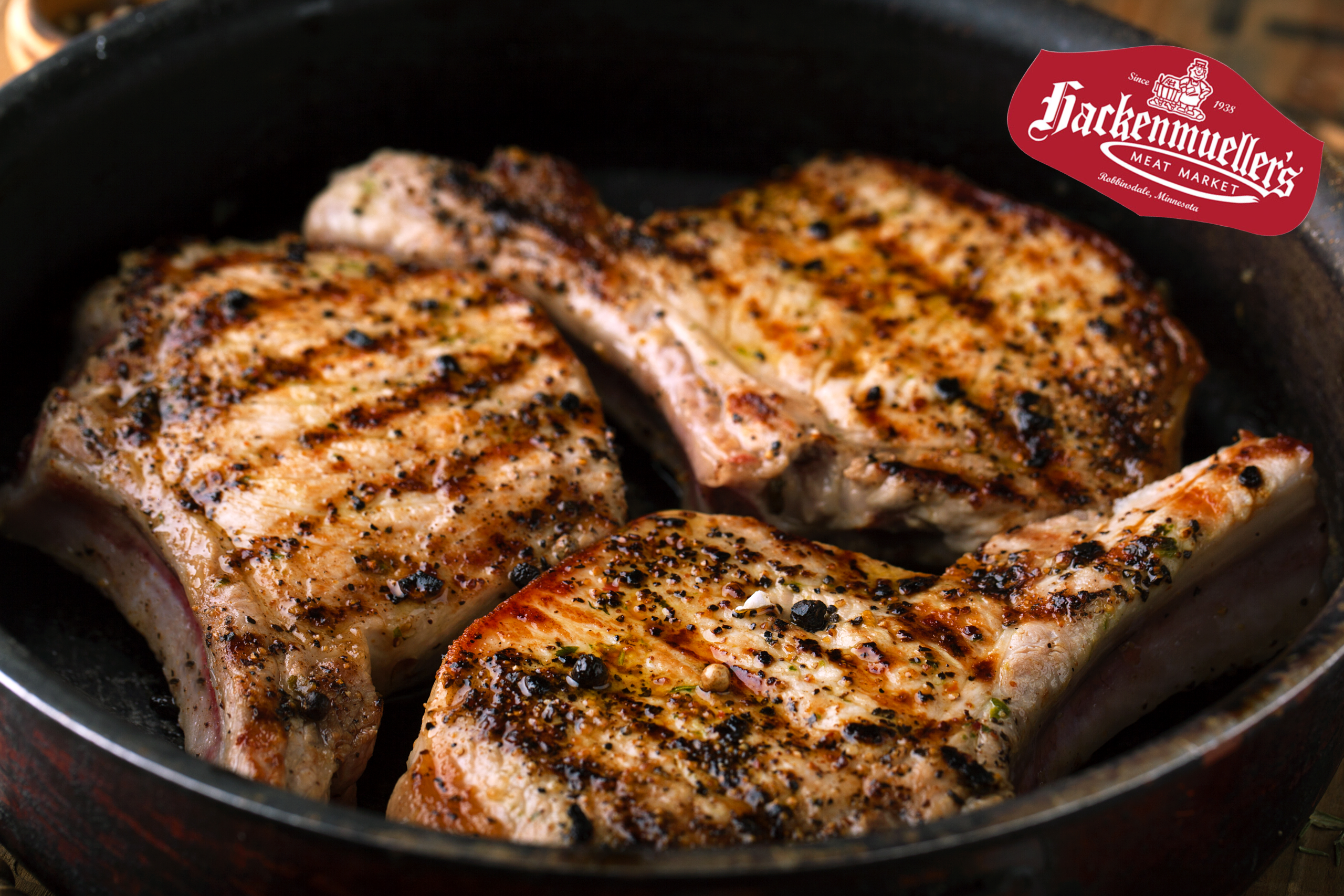
At Hackenmueller Meats, we cut our pork chops thick — inch and a half minimum, sometimes closer to two inches if that’s what you want. And that thickness changes everything about how the pork cooks, how it tastes, and whether your family asks for seconds or quietly feeds the rest to the dog.
Why Thickness Matters More Than You Think
A thin pork chop has almost no margin for error. Thirty seconds too long and you’ve crossed from juicy to dry. There’s no middle ground. The window between undercooked and overcooked is about the width of a credit card. That’s stressful to cook and disappointing to eat.
A thick chop gives you time. You can get a deep, golden sear on the outside while the inside comes up to temperature slowly and evenly. The fat has time to render instead of just sitting there in a chewy strip. The meat stays moist because the exterior crust locks in the juice. You get that contrast between the crusty exterior and the tender center that makes pork chops worth eating in the first place.
This isn’t chef-speak. This is physics. More mass means more thermal buffer. A thicker piece of meat resists temperature change more than a thin one. That means your window for “perfect” is measured in minutes, not seconds. Simple as that.
Butcher Pork vs Grocery Store Pork
The thickness difference is the obvious one. But there’s more going on when you compare a butcher’s pork chop to what’s sitting in the grocery store case.
First, the brine injection. Grocery store pork is often injected with a saline solution — sometimes up to 12% of the total weight. The package will say “enhanced” or “solution added” in small print. What that means is you’re paying pork prices for salt water. The meat looks plumper in the package and weighs more on the scale, but when you cook it, the water cooks out and you’re left with a smaller, drier chop than you paid for.
Our pork doesn’t get injected with anything. What you see is what you’re buying. The marbling, the color, the fat cap along the edge — all natural, all from a hog raised by farmers we know personally.
Second, the cut itself. Grocery store chops are often sliced by machine at a processing plant. The thickness varies. The angle of the cut varies. You might get one chop that’s three-quarters of an inch and another that’s barely half. They don’t cook at the same rate. One is done while the other is still raw in the center. It’s maddening.
We cut by hand. Every chop is the thickness you asked for. Every chop cooks the same. That consistency matters when you’re cooking for four people and you need everything to hit the table at the same time.
How to Cook a Thick Pork Chop Right
You don’t need fancy equipment. You need patience, a heavy pan, and a thermometer.
An hour before cooking, take the chops out of the fridge. Season them generously with salt and let them come up to room temperature. Cold meat seizes up in a hot pan. Room-temperature meat cooks evenly.
Get your pan hot. Cast iron is ideal because it holds heat and transfers it evenly, but any heavy skillet works. Add a tablespoon of oil with a high smoke point — canola, grapeseed, avocado. Lay the chops in away from you. You should hear a sizzle immediately. If you don’t, the pan isn’t hot enough.
Don’t touch them for 4 minutes. You want a deep brown crust. If you move them early, the crust tears and you lose the sear. After 4 minutes, flip. The bottom should be golden brown and release easily from the pan.
Now transfer the whole pan to a 375-degree oven. Let them finish in there until the internal temperature hits 140 in the center. Use a probe thermometer. Don’t guess. Pork is safe at 145, and pulling it at 140 with a 5-minute rest under foil means carryover cooking brings it to perfect temperature.
Rest them. Five minutes under loose foil. If you cut into them immediately, the juice runs out onto the cutting board instead of staying in the meat. Those five minutes make the difference between a juicy chop and a dry one.
Different Cuts, Different Approaches
Rib chops have that curved bone and the eye of loin on one side. They’re the most tender cut and the most expensive. Treat them simply — salt, pepper, a hot pan, and the oven. Don’t overcomplicate a rib chop.
Loin chops look like a T-bone steak. They have the loin on one side of the bone and tenderloin on the other. They’re lean but flavorful. Cook them exactly like a rib chop but pull them at 138 instead of 140 — the tenderloin side cooks faster and you don’t want it to dry out.
Shoulder chops are the dark horse. They’re cheaper and they have more fat and connective tissue. They need slower cooking — braise them instead of pan-searing. Brown them in a pan first, then add a little liquid and let them simmer until the meat pulls apart with a fork. Shoulder chops reward patience in a way that rib and loin chops don’t.
Stop by the shop and ask us to cut you a couple thick ones. Tell us how you’re cooking them and we’ll recommend the right cut. Browse the meat case or see all our services.